Make a loop line
A loop joins the last stop to the first. Vehicles run around it in both directions.
When this helps
A loop around a dense centre can connect radial lines without forcing every transfer through the centre. Riders can travel in either direction, but the complete circuit costs money to construct and needs vehicles and operating funds in both directions.
Step by step
- Choose an eligible type with Draw line and place at least three different stops.
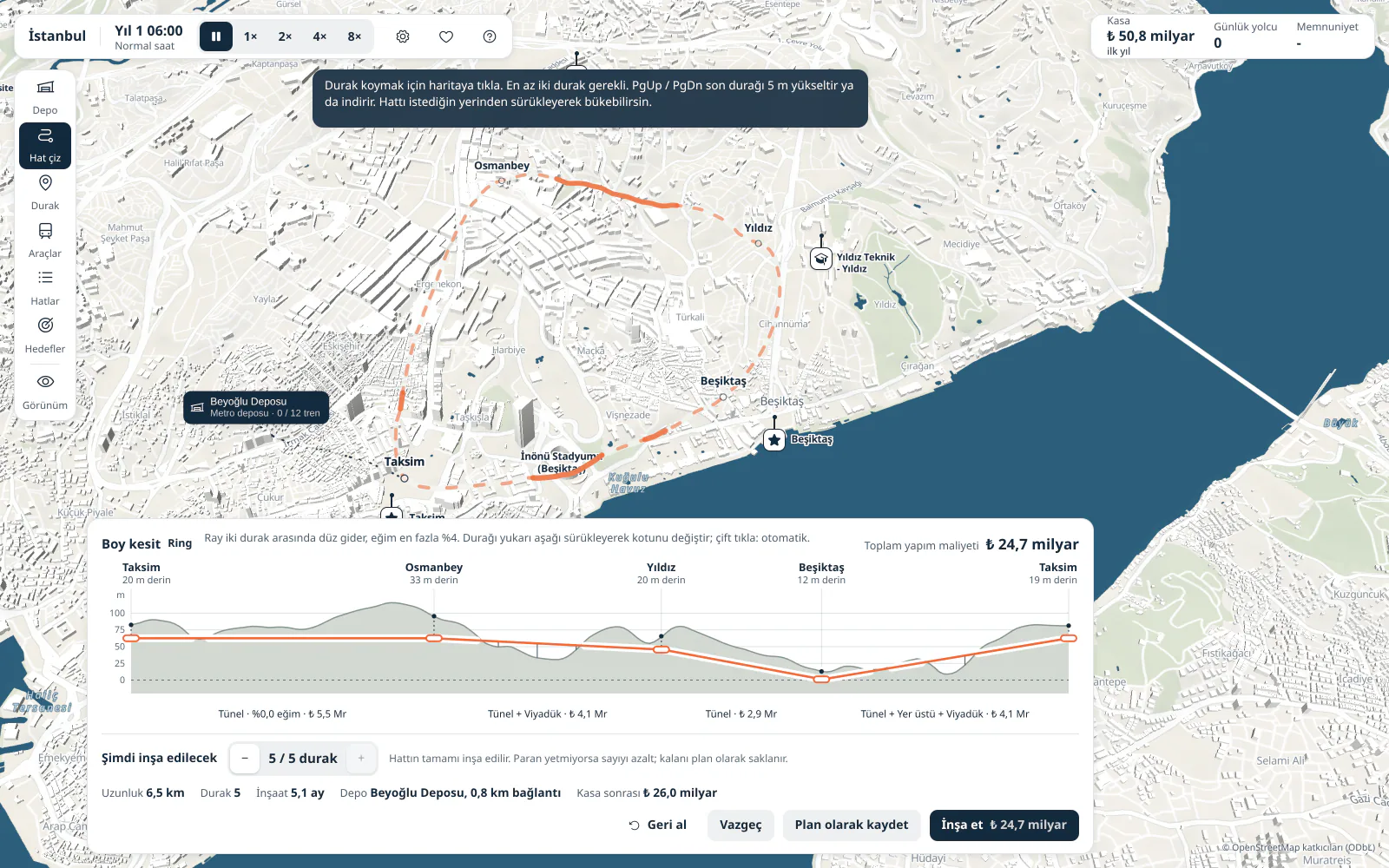
- Click the first stop or press Close loop. Check the Long section and cost, then press Build.
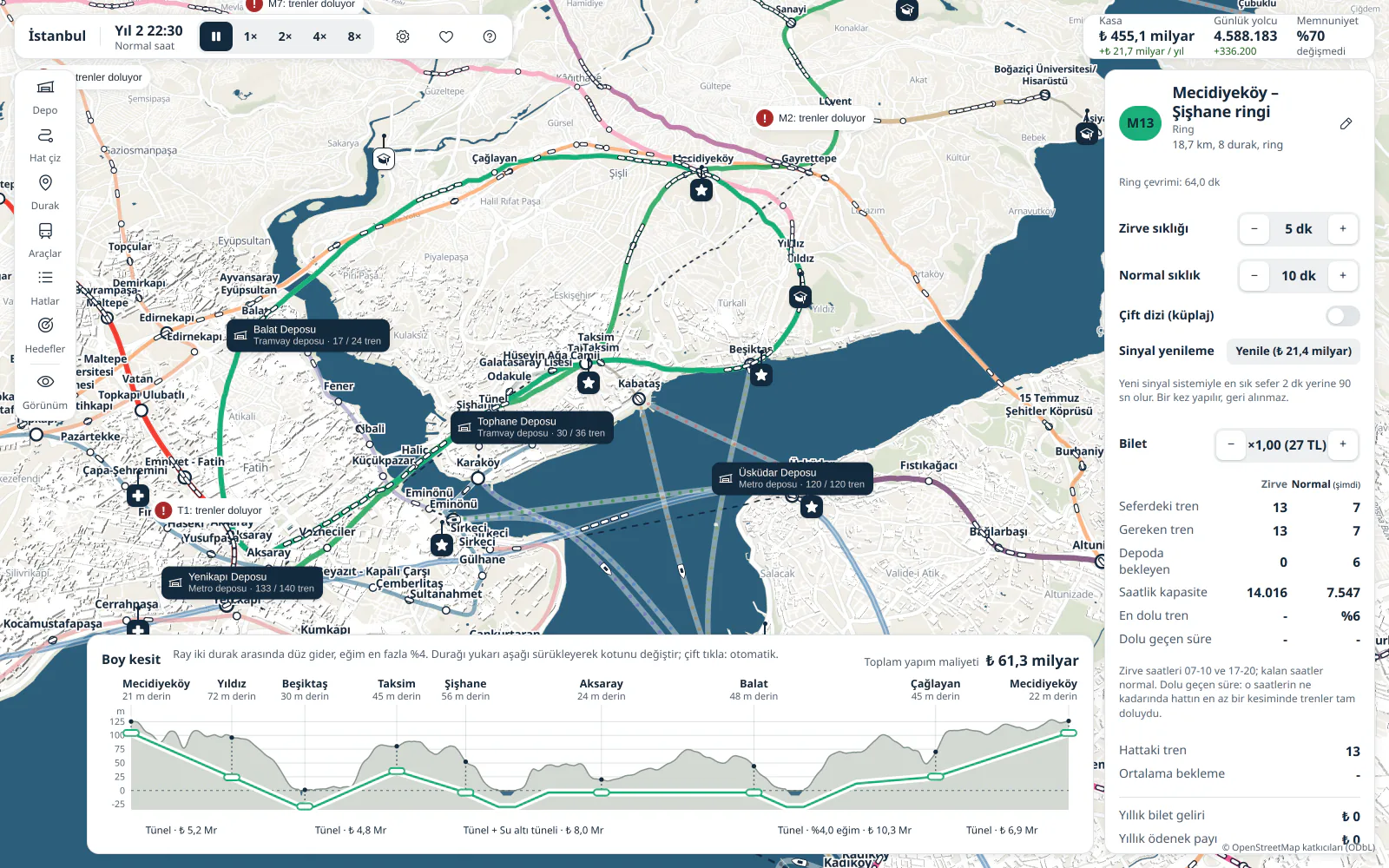
- Once open, assign vehicles and set the frequencies in the line panel. The panel shows the loop cycle time; the number of vehicles needed depends on the cycle and frequency.
- To open the loop, click a station, choose Open loop: remove Kadıköy – Üsküdar for the section and confirm Open loop. 25% of the section cost is returned; this cannot be undone.
Limits and numbers
A loop needs at least three different stops; ferries and funiculars cannot form one. The game divides each section's length by its operating speed and adds dwell time. One lap is the one-way time; the two-direction cycle is twice that. There is no terminal turnaround on a loop. Required service units are the cycle divided by the desired interval, rounded up. Coupling can require more than one vehicle per service unit.
Common errors
If you see “A loop needs at least three different stops.”, add a stop. “Ferries and funiculars cannot form loops.” Choose another type. Immediately after closing a draft, use Undo or Ctrl+Z to undo the closure and add a stop. To extend a built loop, remove a section first.
Tips
- Include the closing section in the construction budget, not just the visible draft so far.
- Check depot space and vehicle prices before shortening the interval.
- A longer circuit needs more vehicles; a longer interval can reduce operating costs when demand is low.
- Opening a loop preserves its stops and removes the selected section. The refund is 25% of that section's calculated cost.
Worked example
Consider an 18 km metro loop with eight stops and only 4-car metro trains. Their top speed is 80 km/h, the metro speed factor is 0.5, and each section includes 0.5 minutes of dwell. One lap takes 18 ÷ (80 × 0.5) × 60 + 8 × 0.5 minutes. The cycle is twice that. For a 5-minute interval, divide the cycle by the interval and round up to find the required service units. With coupling enabled, each unit needs two trains.