How riders choose a route
The game compares lines in service between pairs of open stations. Alongside the fastest route, a suitable route starting on another line can take a share of riders. Journey time includes waiting and transfers as well as time on vehicles.
Which lines count
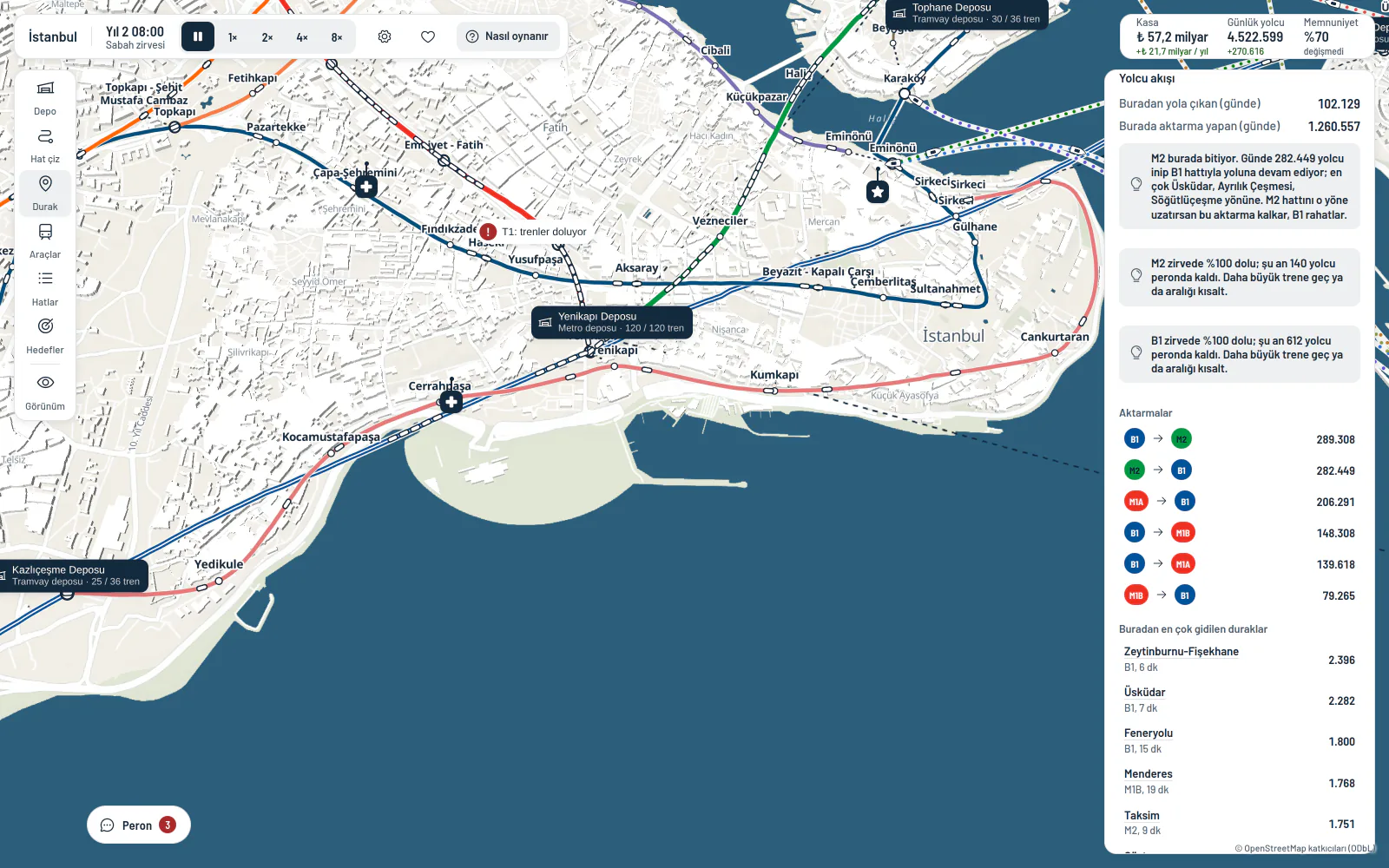
The routing network contains only open lines with vehicles running in that period. Peak and off-peak service are calculated separately; when a line has different headways in the two periods, the route selected for the same journey can change. For each pair of stations the game finds the fastest route, the first line and direction, and the stop where the rider gets off.
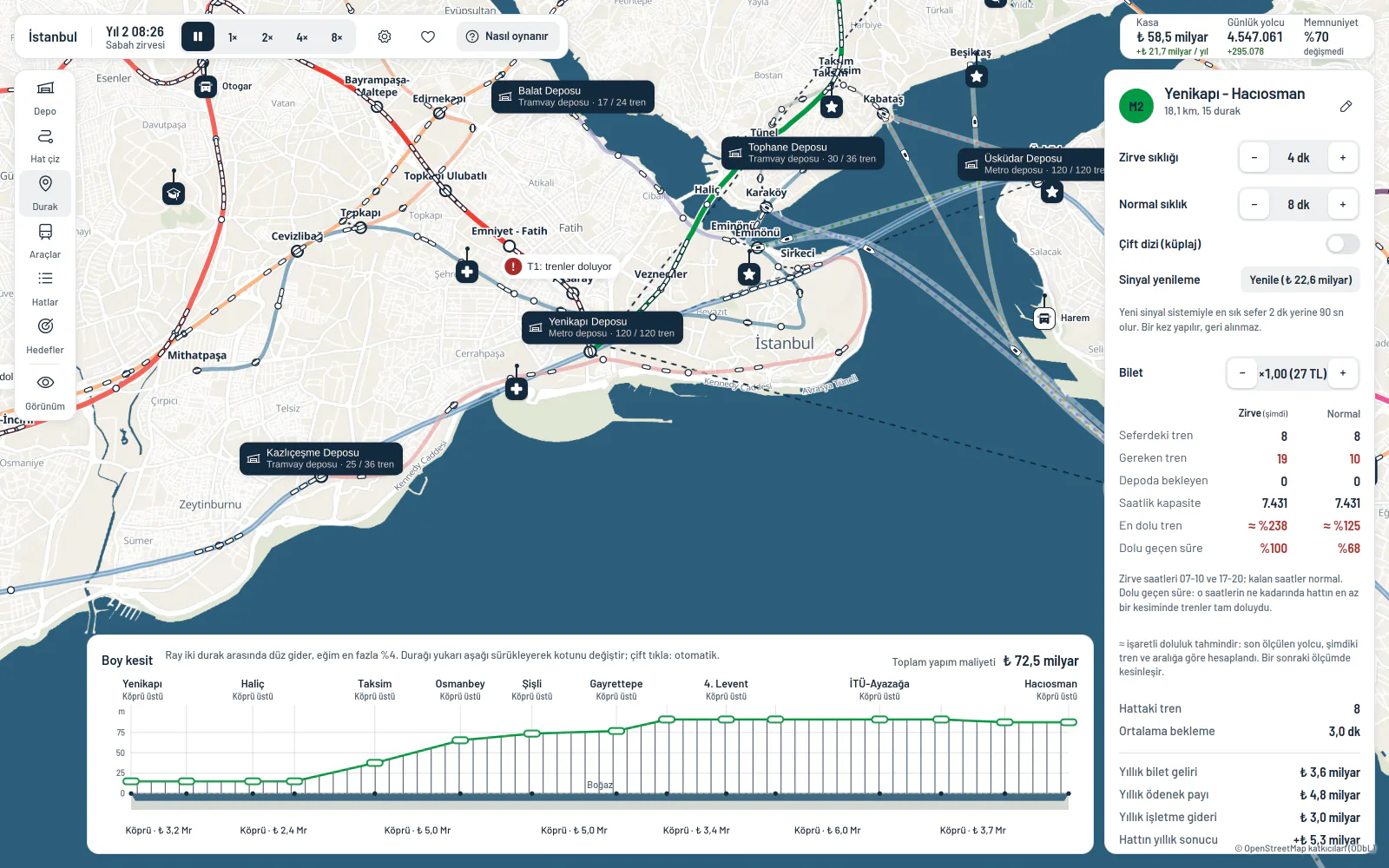
The initial wait is half the running line's actual headway. The depths of the platforms used at the start and end are added, with one minute for every 15 metres. Peak frequency and Off-peak frequency in the line panel set the desired headway. If there are too few vehicles, the actual headway is longer; the wait uses the actual headway.
Changing lines
At a shared station, transfer time is 3 minutes plus the difference in platform depths, converted to one minute per 15 metres. Half the actual headway of the new line is added as waiting time. More frequent service on the second line reduces that wait; a larger difference in platform depth adds walking time.
A walking transfer between separate stations can cover up to 250 metres. If either end is a pier on an open ferry line, the limit is 400 metres. Each station must have at least one line that does not call at the other. The station panel shows walking connections.
The time for a walking transfer is 3 minutes plus the distance between stations divided by 80 metres per minute, plus the two platform depths converted at one minute per 15 metres, plus half the new line's headway. Suitable stations farther apart can be joined by a transfer tunnel up to 800 metres long; the limits are 4 tunnels per station and 256 across the network. The tunnel does not remove walking time.
How riders are shared
The game also looks for the fastest alternative starting on a different line from the fastest route. If it takes more than 20 additional minutes, journeys are not shared. Otherwise the game calculates a perceived time for each route: waiting is multiplied by 1.5, walking by 1.5, and each transfer adds 3 minutes. Time aboard a ferry is multiplied by 0.9.
The difference between the two perceived times, with a factor of 0.12, determines the alternative's share. Equal perceived times split riders equally; the alternative's share falls as its perceived time rises. This sharing is calculated separately from redirection at an overflowing platform.
When a platform fills
If the queue exceeds the 600-person platform limit, the game first looks for another route. It must avoid boardings that were full for at least 20 minutes in the same hour yesterday, start in a different queue and add no more than 25 minutes. Eligible journeys with the smallest extra time are redirected first. Riders still above the limit abandon their journeys.
Waiting on platform in the station panel shows the queue, and the warning sign in the line panel marks stops where full vehicles leave riders behind. The Crowding layer in the View menu colours line sections by their load. Riders who have just changed lines and are waiting for the next vehicle do not count against the platform limit.
Worked example
In Kadıköy, suppose two stations on separate lines are 200 metres apart, each with an open line that does not call at the other. The first platform is 15 metres deep, the second 30 metres deep, and the second line's actual headway is 6 minutes.
- The distance is within the 250-metre limit, so a walking connection forms.
- Transfer time: 3 min + 200 ÷ 80 min + (15 + 30) ÷ 15 min + 6 ÷ 2 min.
- The game adds this transfer to the ride and initial wait, then compares the result with other routes. A shorter headway on the second line reduces the final term and makes the route with a transfer faster.