Building lines
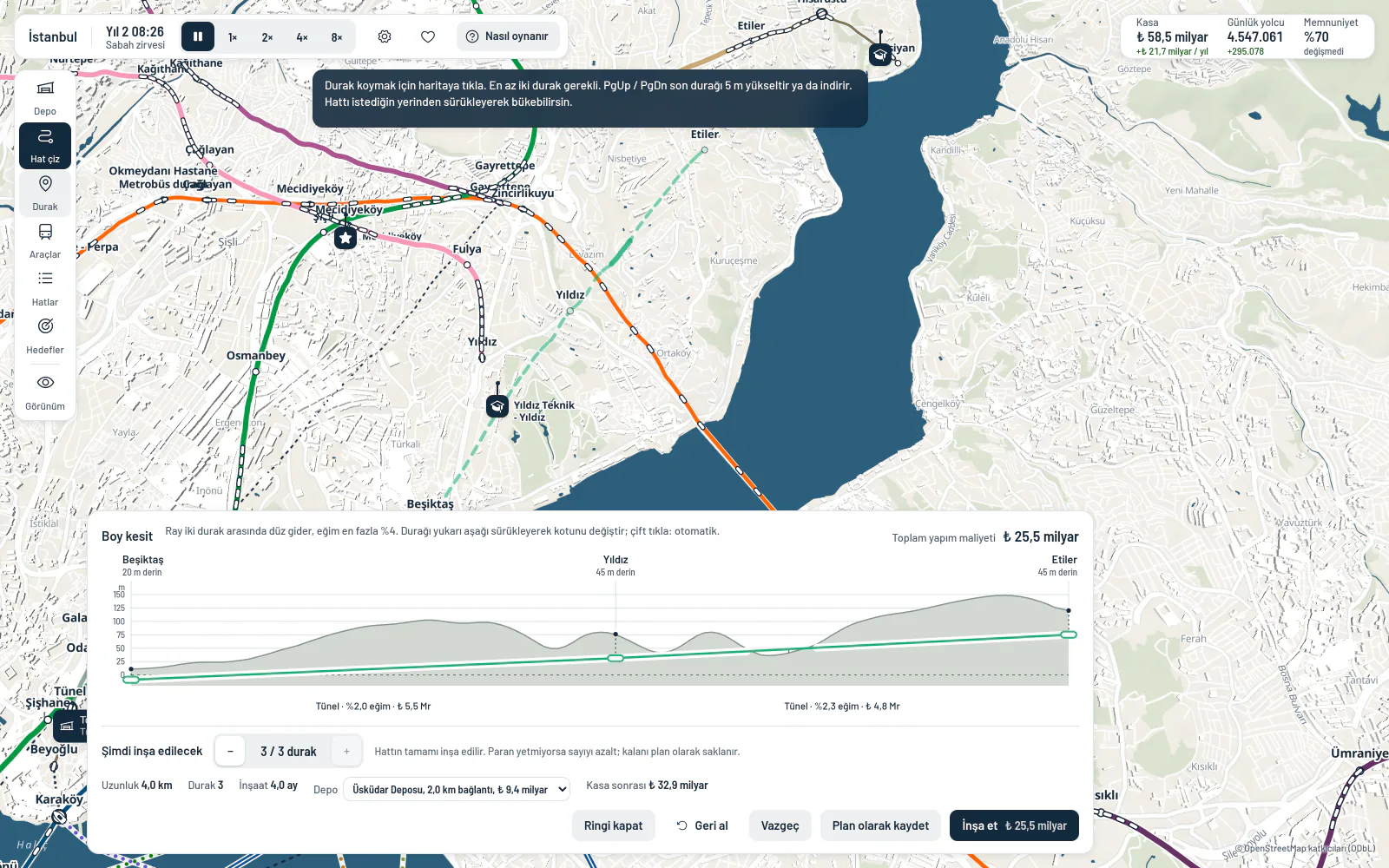
When drawing a line, you choose its transport type, stops and the route between them. The game calculates track sections, stations, the depot connection and construction time and shows them in the preview. Construction starts only when the plan meets the rules and fits the budget.
Choosing a type and stops
Choose an unlocked line type from the menu beside Draw line, then click the stops on the map. Metro, tram, bus rapid transit, commuter rail, funicular and ferry have different route and stop rules. A new metro stop must be at least 400 metres from the other stops in the draft; for a tram the minimum is 150 metres.
Select an existing station to bring lines together at a shared stop. A shared stop provides a transfer; separate nearby stations can also be linked on foot when they meet the conditions. Starting a drawing at the end of an existing line extends that line rather than opening a new one. To start a separate line there, draw from the other end and finish at the existing station.
Route and elevation profile
Add and move bends in a section to change the line's route between stops. The length of the drawn route enters the cost and construction time. For tram and bus rapid transit, Follow road tries to find a route along the road network; if it cannot find a suitable route, the section is drawn straight and a warning appears.
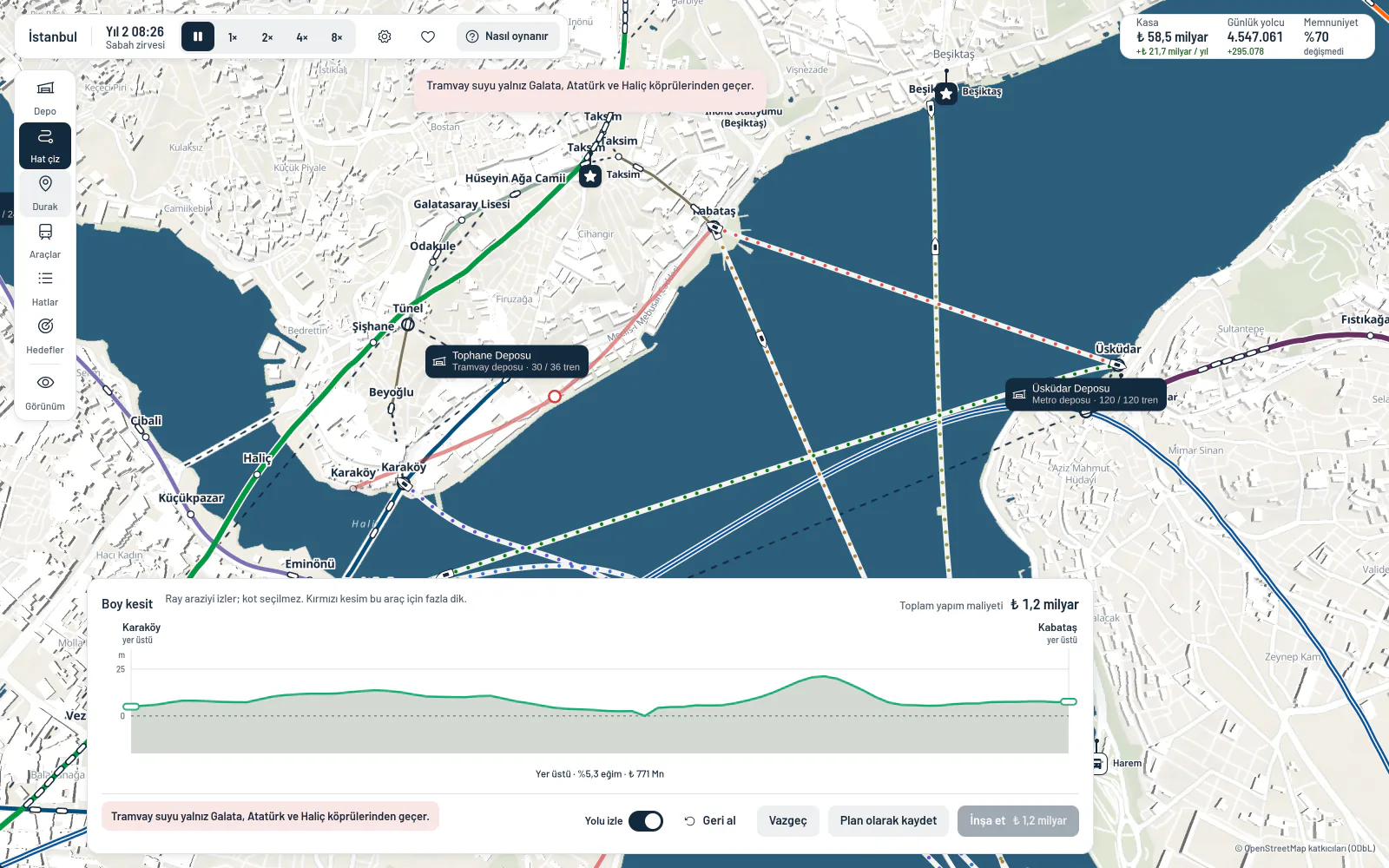
The elevation profile shows the line against the terrain and displays slope warnings. For types whose station levels can be changed, drag a station up or down. Metro can use tunnel and surface sections; tram follows the ground and builds its own bridge across water up to 200 metres wide; for wider crossings it uses only suitable city road bridges. Ferries travel on water and piers must be near the shore. Protected areas, water crossings and slopes are checked separately; clearing one warning does not remove the others.
Connecting a depot
Metro, tram, bus rapid transit and commuter rail connect to an appropriate depot or garage; funiculars and ferries need no depot. Choose the depot in the drawing panel. For a direct link, the closest stop must be no more than 15,000 metres from the depot. The game also checks whether the link crosses water or protected land and whether the depot is the right type.
A shared stop may also connect the line through another line of the same type. The cost of the depot link is added to the preview total. Vehicles can serve a line only from a depot connected to it; the depot must have free space when you buy vehicles.
Cost and construction time
The cost of each section comes from the length of its route and the unit prices of the construction types it passes through. On the surface, local density can increase land costs. A new surface metro station has a base price of ₺450 million; an underground station starts at ₺900 million. An underground station adds ₺28 million for each metre of depth. Joining an existing station is priced separately.
Construction time is the base time plus time per unit of line length and time per new station. Total build cost includes stops, sections and any required depot link. Build starts work on a valid, affordable plan. Save as plan keeps the draft without spending money. Reduce the Build now count and the remaining stops are kept as a plan; they can be built after the line opens.
Worked example
Take a 3 km metro draft in Istanbul with two new stations, one on the surface and the other 30 metres deep. The preview prices the track sections and any necessary depot connection separately.
- Station cost: ₺450 million + ₺900 million + 30 × ₺28 million.
- Add the cost of the 3 km of sections, calculated from their construction types, and the depot link. The preview total combines these items.
- The stations must be at least 400 metres apart. If the plan also passes the slope, water, connection and cash checks, Build becomes available.