Money
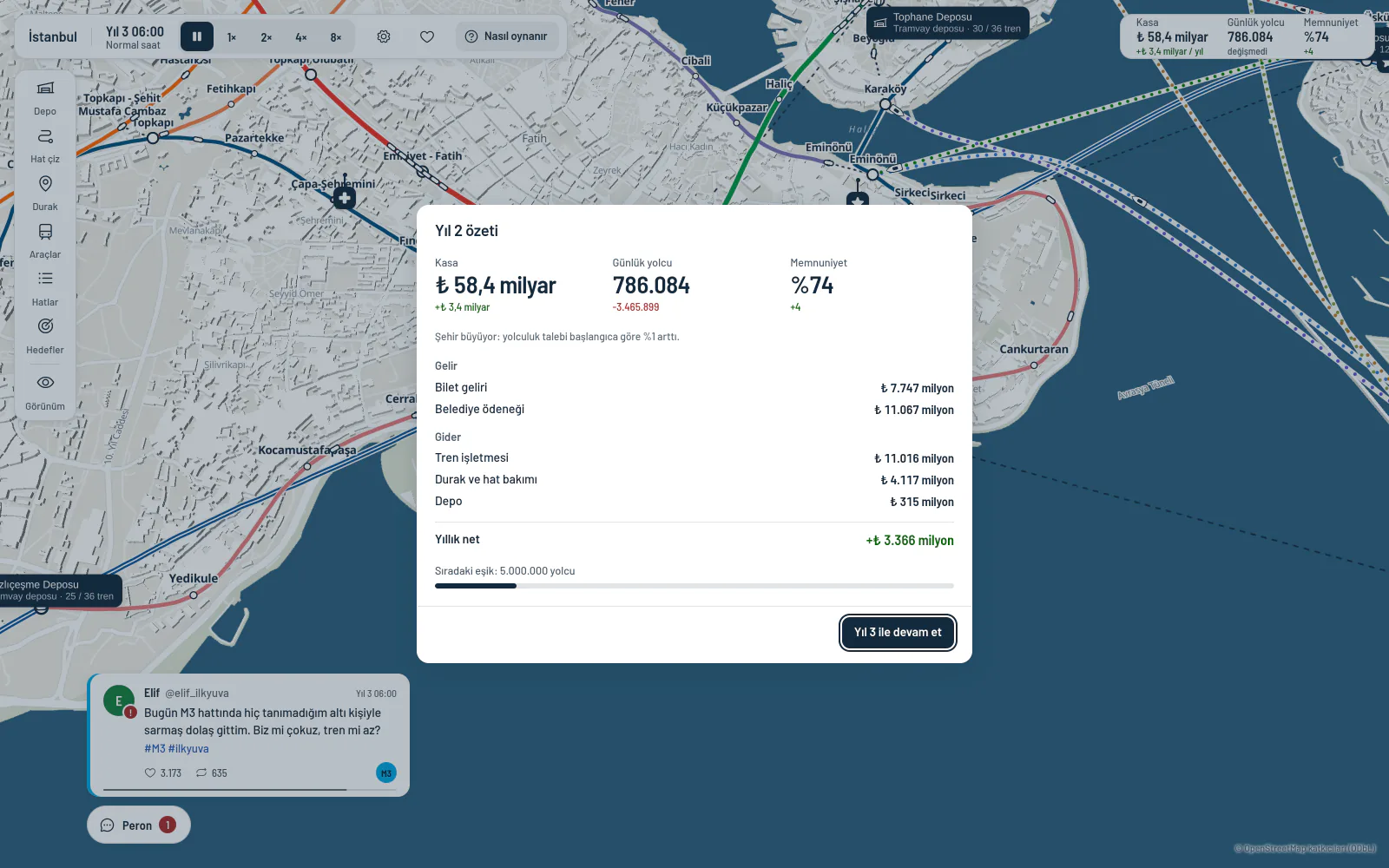
Cash changes with fares, the municipal grant, construction, vehicle purchases, running costs and debt. The annual summary separates income and expenses; the line panel's result looks at one line's journeys and costs.
Fares
A default normal game starts with 55 billion ₺ and a general fare of 27 ₺. A city's starting conditions can differ. Alongside the general fare, you can choose a multiplier between 0.5 and 2 for each line.
A journey on one line costs the general fare multiplied by that line's multiplier. For a journey with transfers, the game adds the multipliers of the lines boarded, divides by the number of boardings and multiplies the average by the general fare. A walking connection between stations does not count as a boarding by itself.
Fare also enters the demand calculation: the ticket price is divided by 6 and treated as minutes added to the trip. Raising the fare increases the price per journey, but can reduce the metro's share against the car. The comparison also includes waiting, time on the train and transfers in the metro journey. Half the headway forms part of the wait. Actual journeys and their fares together determine fare revenue.
The municipal grant
While at least one line is open, the municipality adds a rider-based grant to a fixed grant. The fixed annual amount is 2 billion ₺. The rider-based part starts with the previous day's journeys multiplied by 20,000 ₺.
That amount is multiplied by a factor based on the previous day's satisfaction. The factor is 0.4 plus the satisfaction fraction multiplied by 0.8. As ridership grows through a range set by city scale, the payment per rider gradually falls to a floor. The fixed grant is not subject to this reduction.
Operations and maintenance
Vehicles in service incur crew and vehicle costs. In each period, the units running and their number of cars determine hourly operating costs. Changing the headway can change both the number of units running and the expense; a vehicle waiting in a depot does not incur the service cost.
Open-line length and the line type's maintenance multiplier determine track maintenance. Each station has a base annual cost of 40 million ₺, plus 500,000 ₺ for each metre of underground depth. A shared station uses its greatest depth. Transfer tunnel length also enters track maintenance. Each depot costs 150 million ₺ a year.
Loans and the annual summary
In a normal game the loan increment is 10 billion ₺ and the initial debt limit is 60 billion ₺; progress can raise the limit. Annual interest is 10% of the debt. Interest is recorded as an expense; principal falls only when you repay it. Borrowing increases cash and the debt balance by the same amount. Repayment uses cash and reduces the outstanding debt.
The annual summary subtracts vehicle operations, maintenance, depot costs and interest from fares and the grant to show the net result. Milestone and city goal rewards are added to cash. A line result uses fares and the rider-based grant share from journeys that started on that line on the last completed day, then subtracts the line's annual running and maintenance costs. The fixed municipal grant is not assigned to a line. The net result in the annual summary belongs to the whole network; the line result is calculated separately from journeys starting on that line and its own costs.
Worked example
A rider starts in Kadıköy on a line with a 2 multiplier while the general fare is 27 ₺. The fare is 27 × 2 ₺.
If the rider transfers to another line with a 0.5 multiplier, the game adds the two multipliers and divides by two. It multiplies the general fare by that average: 27 × (2 + 0.5) ÷ two. The fare is lower than for the journey on the high-multiplier line alone. Total annual fare revenue also depends on the journeys actually made.