Where riders travel (demand)
Every game hour the game works out again, for every pair of open stations, how many people a day will make that trip. It takes four steps: who walks to a station, where they want to go, how much of the trip the metro wins from the car, and which hour of the day the trips fall in.
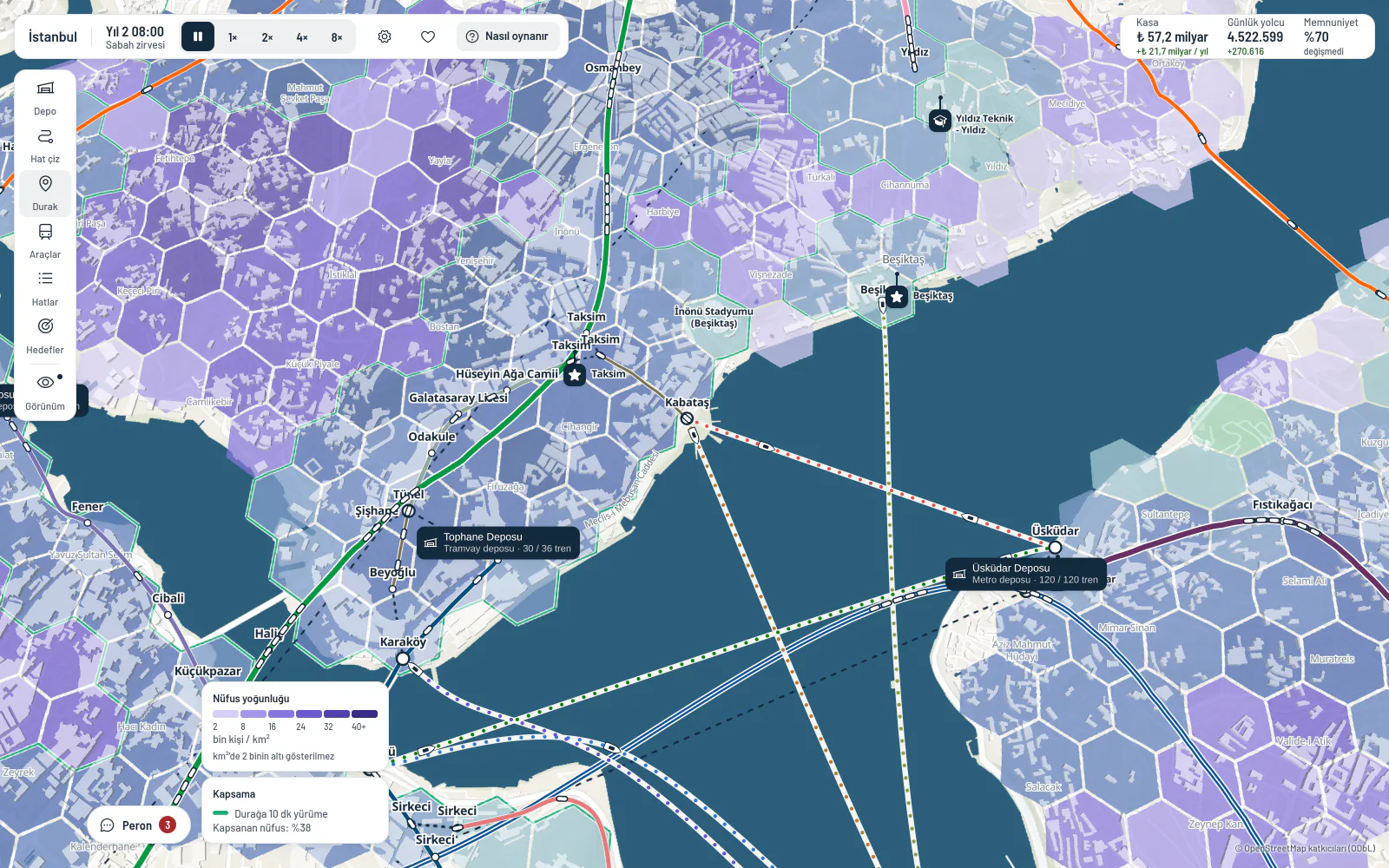
The map is made of cells
The map of Turkey is cut into small cells. Each cell has two numbers: population (the people who live there) and attraction (jobs, schools, shops: the places people go during the day). The Population and Attraction layers in the View menu show them.
A cell makes trips by its population and draws trips by a mix of both: its destination weight is half its share of the city's attraction plus half its share of the city's population. People do not only go to work; visits and trips home go to where people live, too.
Each person makes 2.6 trips a day on average. As the city grows over the years this rises by 1% a year, up to 40%.
Who walks to a station
A metro station's walking radius is 800 m; every kind of line has its own radius (see Line kinds). Inside the radius the will to walk falls in a straight line with distance: full next to the station, half at half the radius, none at the edge.
Where two or more stations reach a cell, its people are shared between them. The nearer station gets the larger share (in proportion to the square of the will to walk), and of that share only the part willing to walk that far comes to the metro. So a second stop nearby takes less from the first than you might expect.
In a shared cell riders lean towards the station that gets them there sooner: each minute of difference shifts the choice by a factor of 0.25. Open a slow line beside a fast one and the slow line cannot take the fast line's riders just by being close.
Where they want to go
Riders leaving a station spread over the other stations the metro reaches. A destination's pull is the product of three things:
- Weight: the destination weight of the cells within the destination station's walking area.
- Nearness: it falls exponentially with distance, on a scale of 6,000 m; at that distance the pull is down to about a third.
- Service: when the metro wins at least 30% of that trip against the car, the destination pulls in full; below that its pull drops very fast.
Places the metro does not reach count too: people want to go there as well, and those trips never come to the metro. That is why old stations gain riders as the network grows: people at a station that reaches more places use the metro more often.
Metro or car
For every trip the metro's time is set against the car's.
Metro time: 8 minutes of walking, getting down to the platform and up again (a minute for every 15 m of depth), waiting (half the headway plus any delay building up on the platform), time on the train and transfers. The fare counts as time too: fare ÷ 6 minutes.
Car time: 11 fixed minutes (parking, lights) plus the road. The road is taken as 1.35 times the straight line; the car runs at 18 km/h in the rush hours and 28 km/h the rest of the day. A trip across the Bosphorus adds 25 minutes of bridge delay.
The metro's share comes from the difference: equal times give the metro half the riders, and each minute the metro is faster raises its share by a factor of 0.12. The car is slower in the rush hours, so the same line carries more riders then.
Hours of the day
A game day is 18 hours. Outbound trips crowd into the morning rush, return trips into the evening rush, each with its own hourly spread. In the rush hours the game uses each line's peak headway and the car's rush-hour speed. A train that fills one way in the morning fills the other way in the evening.
A new line
A new line's riders do not arrive at once: over 180 game minutes it climbs from nothing to full demand, and during that time demand is worked out again every ten minutes. Do not judge a line by its opening hour; look at the next day.
Worked example
Take a trip from Kadıköy to a centre 6 km away, in the rush hour, 20 minutes by metro with waiting and transfers. The fare is ₺27.
- Metro: 8 min walking + 20 min travelling + the fare (27 ÷ 6 min) = about half an hour.
- Car: 11 min + 6 km × 1.35 ÷ 18 km/h ≈ 40 min.
The metro is a few minutes ahead: more than half the riders take it, and since its share is above 30% the destination pulls in full. Outside the rush hours the car speeds up to 28 km/h and the trip is nearly even; the metro's share comes close to half. A shorter headway cuts the wait, and so raises the share directly.