Services and vehicles
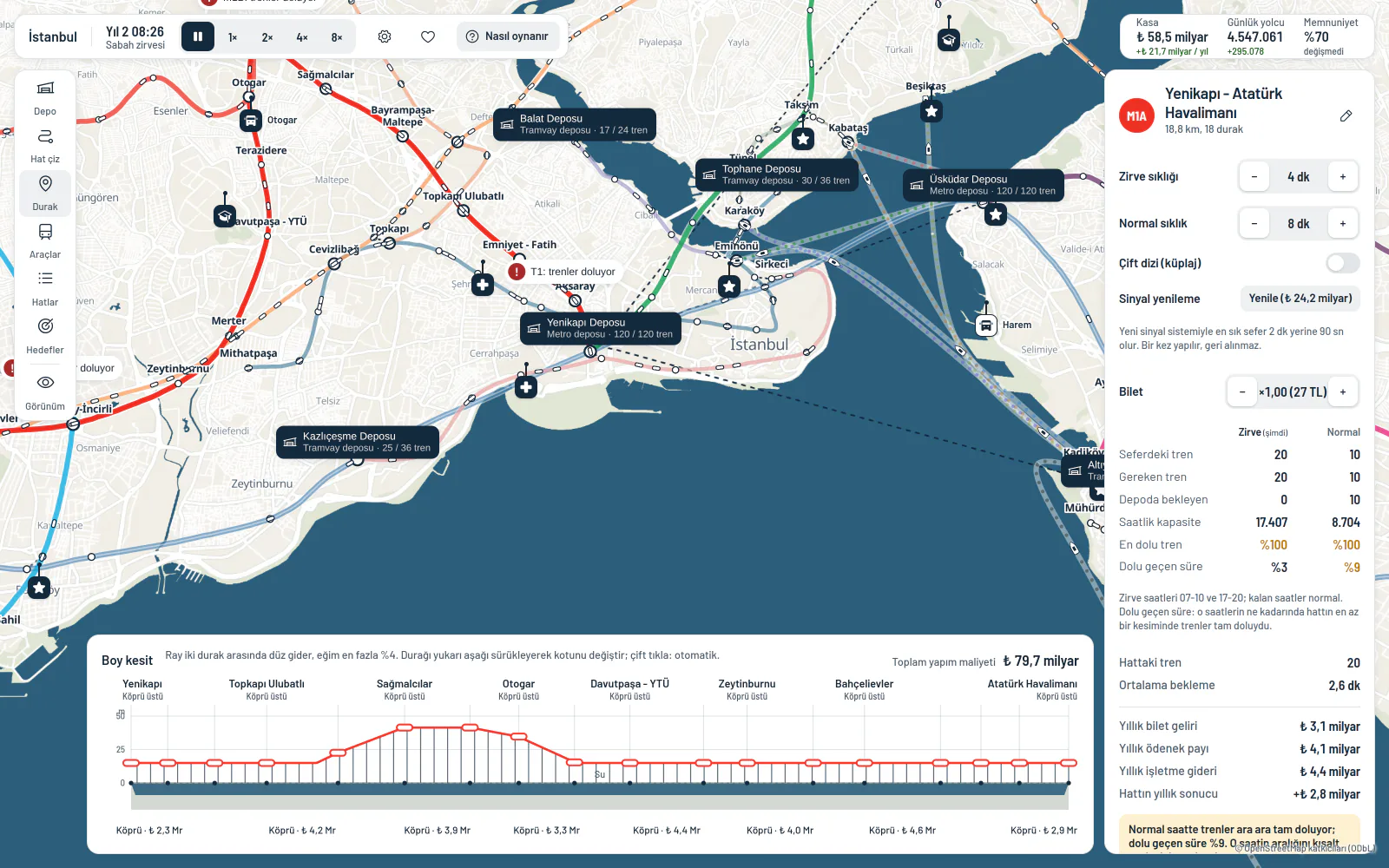
A line's headway depends on the time vehicles take to complete a round trip and the number of service units assigned to it. The line panel shows peak and normal periods separately, and lets you choose a headway for each.
The round trip
The game adds running times between stops and dwell times at stops to get the one-way time. Round-trip time is twice the one-way time plus turnaround at both ends. A ring has no end turnaround.
Running time depends on line length and speed. If different vehicles are assigned, the calculation uses the lowest maximum speed among them. For types sharing street space, speed can fall as the average density around the stops increases. Extending the line or assigning a slower vehicle can lengthen the round trip.
Selected and actual headways
The initial metro peak headway is 5 minutes and the normal headway is 10 minutes. Other line types have different choices. For each period, the game divides round-trip time by the selected headway and rounds up to find the number of service units needed.
The number running is the smaller of the number needed and the number assigned. Actual headway is round-trip time divided by units running. With no units running there is no service. A signal failure can also limit the number of units able to run. A funicular has fixed vehicles and service.
Capacity per minute is the sum of the running units' capacities divided by round-trip time. The game puts the highest-capacity units into service first. The line panel shows measured occupancy; after a change to vehicles or headway, a value marked with an approximation sign can be estimated against the new capacity.
Fleet and depots
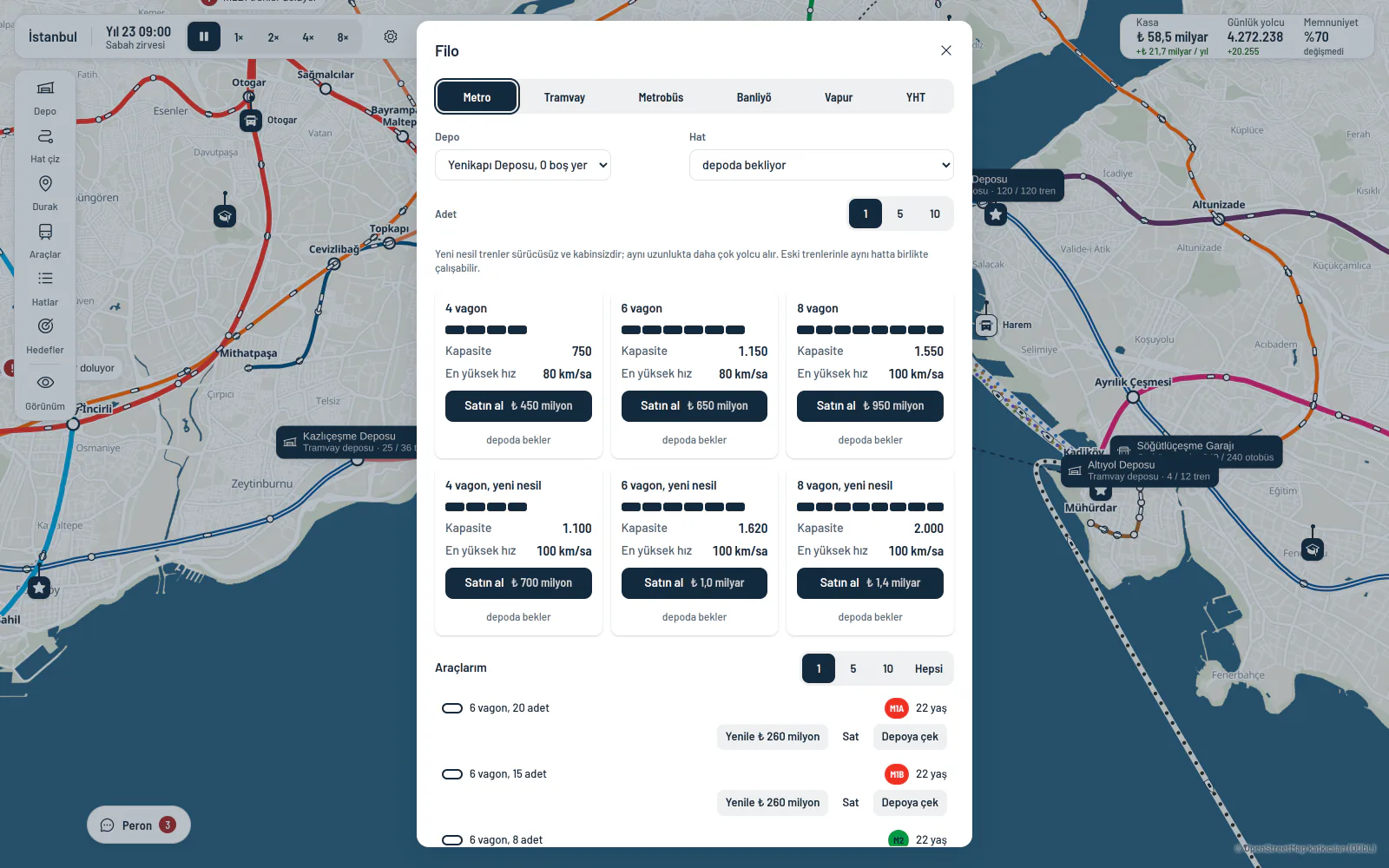
The Fleet window shows vehicle prices, capacities and speeds. You can buy an unlocked vehicle into a suitable depot to wait there, or assign it to an open line linked to that depot. A vehicle on a line must be taken out of service before moving to another depot. The depot must have enough room; a new depot starts with 12 places and can be expanded through progress.
A ferry needs no depot: it is bought for an open ferry line, waits at the pier and can be assigned to another open ferry line free of charge. Funicular vehicles are not bought separately.
Coupling, convoys and signalling
Eligible vehicles can be coupled in pairs; an unmatched vehicle runs alone. In a bus rapid transit convoy, vehicles are ordered by capacity, largest first, and grouped by the selected convoy size. The last group can contain fewer vehicles. A unit's capacity is the sum of the capacities of its vehicles; combining vehicles can reduce the number of separate units available to run.
Milestones unlock signalling upgrades for metro and commuter lines. The price is calculated from line length and number of stops. The line must be open, have no construction in progress, and have enough cash available. An upgrade opens shorter headway choices; the units needed for that headway are calculated separately from the round-trip time.
Vehicle age
Once ageing is unlocked, each year after 20 years removes 2% of capacity, up to a total loss of 30%. An overhaul costs 40% of the vehicle's price, resets its age and restores its capacity.
Worked example
Suppose a metro line in Kadıköy takes 30 minutes for a round trip. Its initial peak selection is 5 minutes. The game divides 30 minutes by 5 and rounds up to find the units needed. If fewer units are assigned, it divides 30 minutes by the number running and shows a longer actual headway.
If each unit is one 4 cars, its capacity is 750 riders. Add the capacities of the running units and divide by 30 minutes to find capacity per minute. With the same number of new 4 cars, new generation units, each unit holds 1,100 riders, so capacity per minute rises.