Troubleshooting
Full vehicles, a missing transfer and a line that cannot be built involve different calculations. Line and station panels show service; the drawing preview shows construction conditions and costs.
Vehicles and platforms are full
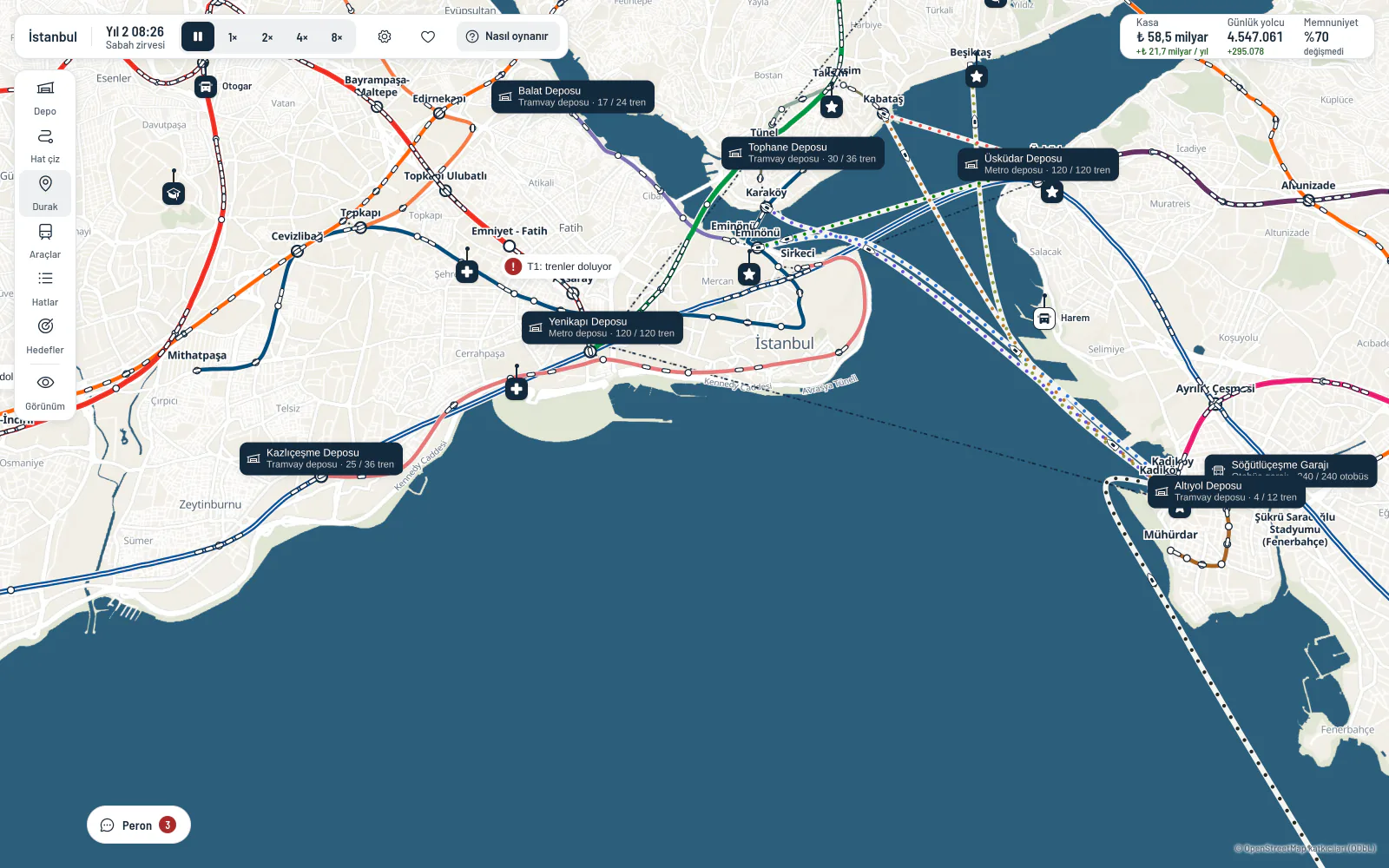
The Crowding layer in the View menu colours line sections by their load. Waiting on platform in the station panel shows the queue. The warning sign in the line panel marks a stop where a full vehicle leaves riders behind. Riders who have just changed lines and are waiting for the next vehicle do not count against the platform limit.
Set Peak frequency and Off-peak frequency separately in the line panel. The vehicles needed are the round-trip time divided by the chosen headway, rounded up. If too few vehicles are assigned for a shorter headway, the actual headway is longer. Coupling eligible vehicles changes capacity; once unlocked, Signalling upgrade permits a shorter headway to be selected.
If the queue exceeds the 600-person platform limit, the game first looks for another route. It must avoid boardings that were full for at least 20 minutes in the same hour yesterday, start in a different queue and add no more than 25 minutes. Riders still above the limit after redirection abandon their journeys. A parallel line does not carry the whole queue regardless of those conditions.
A new line carries few riders
Demand for new service rises from zero to its full level over 180 game minutes. The demand calculation compares waiting, time aboard, transfers and the fare against a car journey. A shorter actual headway reduces waiting; a higher fare raises the calculated cost of the journey. As open lines in service reach more stations, the destinations riders can reach also change.
A transfer does not appear
If each of two separate stations has a line that does not call at the other, a walking connection forms up to 250 metres apart. If either end is a pier on an open ferry line, the limit is 400 metres. Only open lines count for riders; connections appear in the station panel.
Suitable stations farther apart can be linked by a transfer tunnel up to 800 metres long. A tunnel cannot cross water; the limits are 4 per station and 256 across the network. Selecting the same station as a shared stop on both lines also connects them. Walking and waiting for the next line are added to the time of a route with a transfer.
A depot link or drawing is rejected
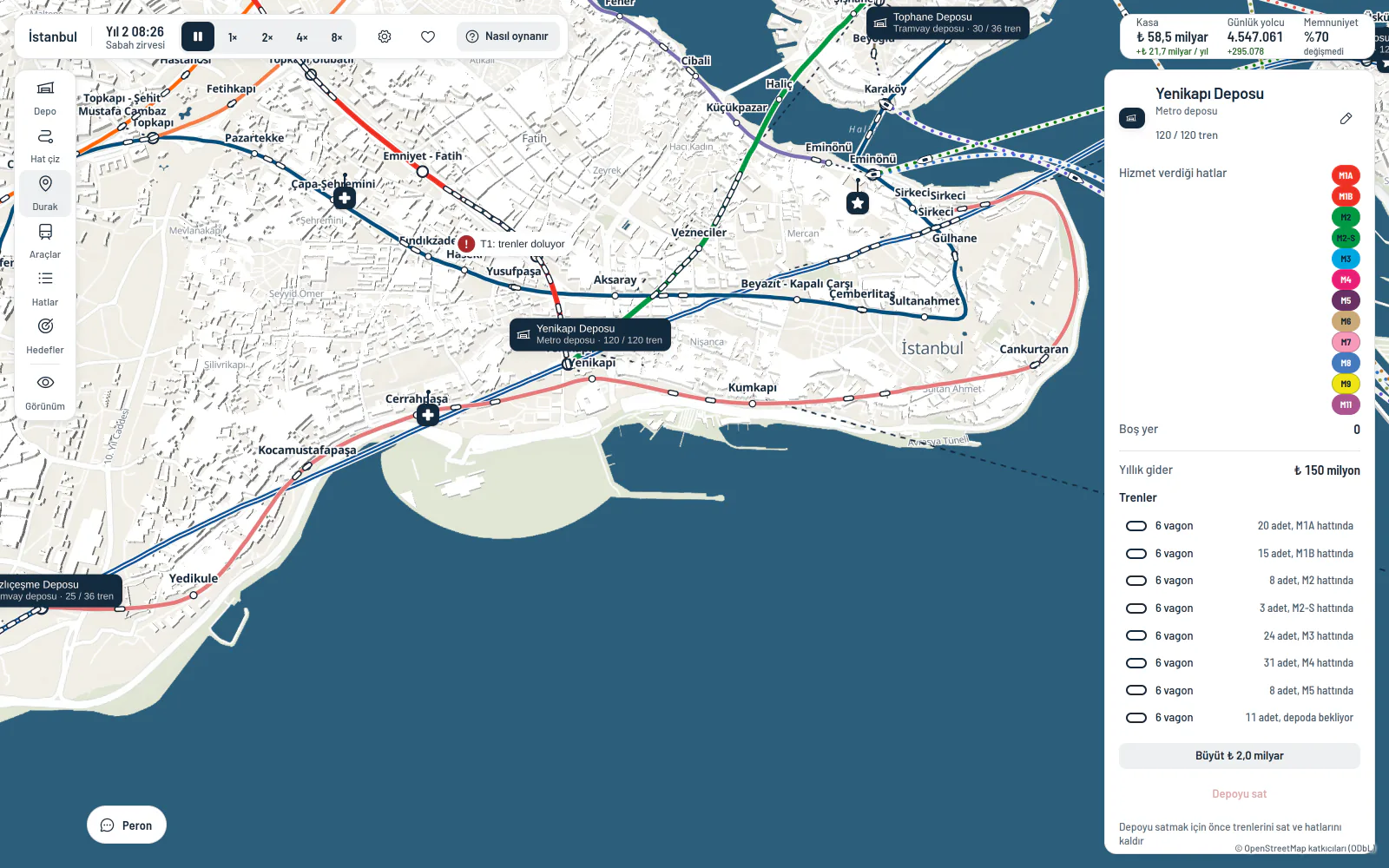
Metro, tram, bus rapid transit and commuter rail need a depot or garage of the right type. For a direct link the nearest stop may be no more than 15,000 metres from the depot. The game also checks whether the link crosses water or protected land and whether the depot is the right type. Funiculars and ferries need no depot. The line panel shows connected depots; a vehicle in an unconnected depot cannot run on the line.
A slope warning in the drawing means a section exceeds the type's slope limit. Moving a stop, bending a section or changing a stop's level for a suitable type changes the route. Follow road uses the road network for tram and bus rapid transit; water-crossing rules still apply. Total build cost includes sections, stops and any required depot link. If cash is short, reduce Build now and the remaining stops are saved as a plan.
Worked example
In Kadıköy, suppose two separate stations are 300 metres apart, each with an open line that does not call at the other, and neither is a pier.
- At 300 metres they exceed the 250-metre walking limit, so no automatic connection forms.
- The distance is below the 800-metre tunnel limit. The tunnel price is ₺300 million + 300 × ₺1 million.
- If the water, tunnel-count and cash checks also pass, the tunnel connects them. The route time adds 3 minutes, 300 ÷ 80 minutes of walking, platform depths and the wait for the new line.